Teachers often notice that children come back from family trips with new energy and new things to talk about. Camping is especially good at this. Away from screens and schedules, kids solve real problems, use real numbers and tell real stories. With a little planning, parents can turn a weekend at a campsite into a gentle boost for reading, math, science and teamwork, without it ever feeling like school.
Below are simple camping activities for elementary-age children, grouped by the skills they help build. Most need nothing more than a notebook, a pencil and the great outdoors.
Why Outdoor Learning Works
Learning by doing, sometimes called experiential learning, helps children remember ideas because they connect them to something they touched, saw or built. Outdoor education programs use this idea in many schools, and a family camping trip is a natural, low-pressure version of it. Kids are curious, active and relaxed, which is exactly when learning sticks.
Reading and Writing Activities
- Camp journal: each evening, kids write three sentences about their day and draw one picture. Younger children can dictate while a parent writes.
- Trail sign reading: let kids read the trail maps and information boards out loud and explain them to the family.
- Postcard home: kids write a short postcard to a grandparent or friend describing the campsite.
- Story by the fire: take turns adding sentences to a group story, a fun way to practice sequencing and imagination.
Math Activities
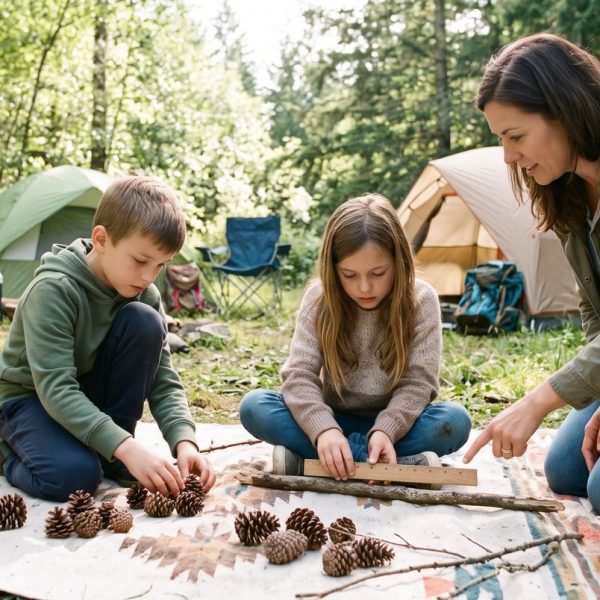
- Pinecone counting: younger kids count, sort and group pinecones or rocks by size.
- Measure the campsite: use footsteps to measure the distance from the tent to the picnic table, then compare with an adult's steps.
- Trail math: if a loop trail is 2 miles and you have walked 1.5, how far is left?
- Camp budget: older kids can help plan snacks with a set amount of money.
- Cooking fractions: half a cup of water, a quarter of the pancake mix, a third of the bag of marshmallows each.
Science Activities
- Leaf and bark rubbings: place paper over leaves or tree bark and rub with a crayon, then compare patterns.
- Bug watch: use a magnifying glass to observe ants, beetles or caterpillars, and count their legs.
- Shadow tracking: mark the end of a stick's shadow every hour to see how the sun moves across the sky.
- Weather log: record the temperature and clouds each morning and evening.
- Star finding: on a clear night, find the Big Dipper and use it to locate the North Star.
Social and Life Skills
Some of the most valuable lessons at camp are not academic at all. Camping asks children to cooperate, take responsibility and handle small challenges:
- Helping set up the tent teaches teamwork and following steps in order.
- Having a camp job, like filling water bottles or collecting kindling, builds responsibility.
- Getting through a rainy afternoon or a long hike builds patience and resilience.
- Sharing a small space with siblings is good practice for solving disagreements calmly.
A practical Times Bay guide to camping activities for kids also suggests involving children in planning and packing. Letting them help write the packing list or choose the meals builds planning skills that carry straight into the classroom.
A Simple Learning Scavenger Hunt
Write a short list on an index card and send kids out with a parent to find:
- Something that starts with the letter B
- Three leaves of different shapes
- Something smooth and something rough
- An object longer than your hand
- A sign that an animal has been here
- Something that makes a sound
When they return, ask them to explain each find. Speaking about what they saw is great practice for show-and-tell and class presentations.
Match Activities to Your Child's Age
Kindergarten to first grade: focus on counting, colors, shapes and simple words. Collect five red things, find a circle in nature or spell "tent" with sticks.
Second and third grade: add measuring, simple maps and short journal entries. Kids can draw a map of the campsite with a key for the tent, the fire ring and the trail.
Fourth and fifth grade: try longer writing, budgeting, reading a real trail map and recording weather data over several days. Older kids also enjoy teaching younger siblings what they have learned.
Pack a Small Learning Kit
A shoebox-sized kit makes these activities easy. Include a notebook for each child, pencils and crayons, a magnifying glass, a small ruler or tape measure, a compass, index cards and a simple field guide to local birds or trees. Keep it in the car so it is always ready, even for a quick picnic stop.
Bring the Learning Back to School
After the trip, encourage children to share their camp journal or photos with their teacher or class. Many teachers love when students bring real experiences into lessons about habitats, weather, maps or writing. A leaf collection or a sketch of a constellation can start a great conversation.
Keep It Light
The secret is to keep these activities playful. Offer them as games, not assignments, and let children choose what interests them. If a child would rather spend an hour building a stick fort, that is learning too: planning, engineering and teamwork all in one.
Learning Under the Open Sky
A camping trip can quietly strengthen many of the skills children use at school, from reading and counting to observing and cooperating. With a notebook, a few simple games and a curious attitude, the campsite becomes a classroom without walls, and kids come home with stories, new skills and a little more confidence.